

Show up and make your voice heard, maybe for the last time, on Tuesday, August 19, 2025 when the Board will vote to eliminate non-agenda public comments. (Time to be determined.)
On Tuesday, August 5th, 2025, Plano ISD Board Agenda Item 9.7 Adoption of Policy BED(LOCAL) Board Meetings: Public Participation under First and Final Reading was introduced as a Strategic Plan Pillar of Safety, Wellness & Community Engagement to remove Non-Agenda Public Comments from Board Meetings.
That’s right, to foster community engagement and transparency the District would like to remove non-agenda public comments from the community.
This is being done under the guise of new requirements under Texas Senate Bill 12 which just passed this past 89th Texas Legislative Session.
To be clear, this is what SB 12 is requiring which the Plano ISD Board was discussing:
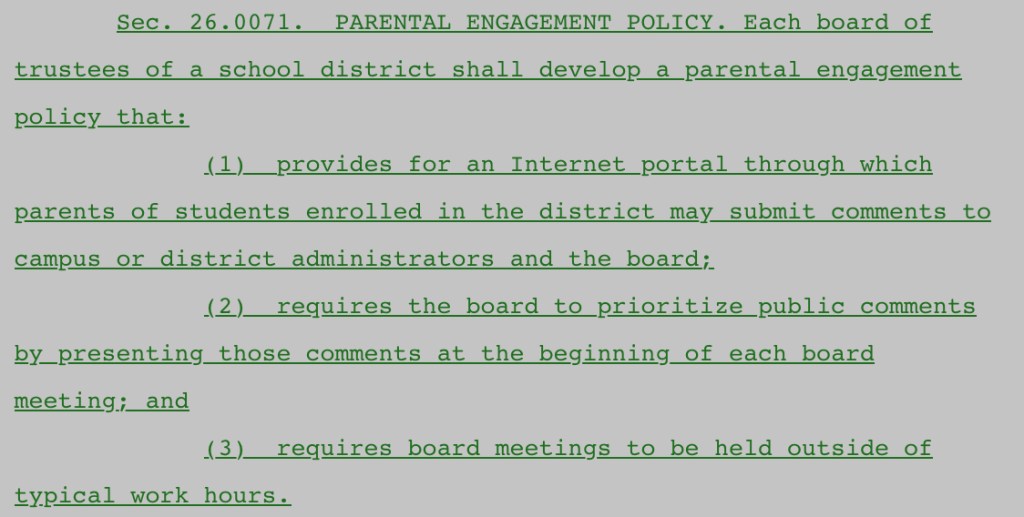
Notice, there is no prohibition against non-agenda public comments, but there is now a requirement that all public comments occur at the beginning of each Board Meeting.
So it appears what the Plano ISD Trustees and Superintendent are really concerned about is that if they continue to allow non-agenda public comments, they’ll no longer be able to discourage these comments as they have been by forcing them to be heard at the end of their excessively long Board Meetings. Instead, the Board would have to hear these comments at the beginning of the meeting, per the law.
For parents, students, staff, and community members, non-agenda public comments is often a last resort when they cannot get a response from District leadership via the channels already in place (like Let’s Talk, email, phone calls, letters, etc.).
Trustee Michael Cook came to save the day. He clearly articulated his position, yet his fellow Trustees refused to acknowledge his concerns, contorting SB 12 into something it is not. For several minutes, fellow Trustees attempted to convince Trustee Cook and the audience that eliminating non-agenda public comments was in the best interest of the community. Trustee Cook said there is value in non-agenda public comments and that they add just minutes onto a meeting; parents and students value the opportunity to be heard. Trustee Cook even stated that at times non-agenda public comments have changed his perception on issues.
EXACTLY.
According to Trustee Humphrey, in 2010 she advocated for including non-agenda public comments in their Board Meetings but now in her great wisdom has decided that an already existing online portal (where concerns go to die) is the most transparent way for parents to have their voices heard. She stated “I believe that the community has a voice, and I still believe that today,” yet she believes it’s better to remove non-agenda public comments because it’s at the end of the meeting and parents get upset.
Not so fast.
The Board has always been allowed to have non-agenda public comments at the beginning of Board Meetings but has chosen not to. The new law would solve this by requiring non-agenda public comments to be heard at the beginning.
Trustee Lantz feels that the public doesn’t understand how Board Meetings work, and there is soooo much work that public comments just hinder the valuable policy work the Trustees do. Trustee Lantz also does not understand how non-agenda public comments help “the kids.” She also seems to equate non-agenda public comments with a public forum. These are two completely separate things.
Trustee Tyra believes the influencers and bloggers do enough to bring knowledge to the public and therefore no need for direct non-agenda public comments to the Board. That was a little weird. What? It sounds like she would rather have bloggers and websites do the job that she was elected to do so that she can get lucky every night and not have to hear constituents. In one breath, Trustee Tyra says “freedom of speech, totally, I will die on that hill” and in the next breath says that she believes they should remove non-agenda public comments. Though we appreciate the vote of confidence Trustee Tyra gave to alternative media such as Educate Plano, which provides valuable insight and opportunities to engage the public, this is not an excuse for removing non-agenda public comments as she suggests.
Trustee Johnson appears to only believe that the LGBTQ community will be harmed by not having the opportunity to make non-agenda public comments, no other group has any concerns to speak about.
Several times Trustees acted as though they had no way to dialogue with public commenters and for that reason wanted to abolish non-agenda public comments in favor of a two-way communication system. As Trustee Cook pointed out, they’ve always had a two-way communication system known as a mass email to the Board. For clarification, Trustees have always had a way to contact individuals who gave public comments as the sign-up requires speakers to share their contact information. Additionally, the Board has always permitted any misstatements during a public comment to be immediately addressed at the meeting by the Board and/or Administration.
In the end, the vote was made to table this agenda item for the upcoming August 19, 2025 Work Session. Work Sessions do no permit non-agenda public comments like regular Board Meetings do.
This is not rocket science. The only thing SB 12 does is change the public comments such that all public comments (on-agenda and non-agenda) are prioritized to be heard at the beginning of the meeting. So if the Board has acknowledged that the community is upset about non-agenda public comments being heard at the end of hours-long meetings, they should be pleased that this law will address that.
But instead, they appear to be resisting this law as a way to gate-keep and control the information being shared to a wider audience: the public at large.
 Educate Plano